
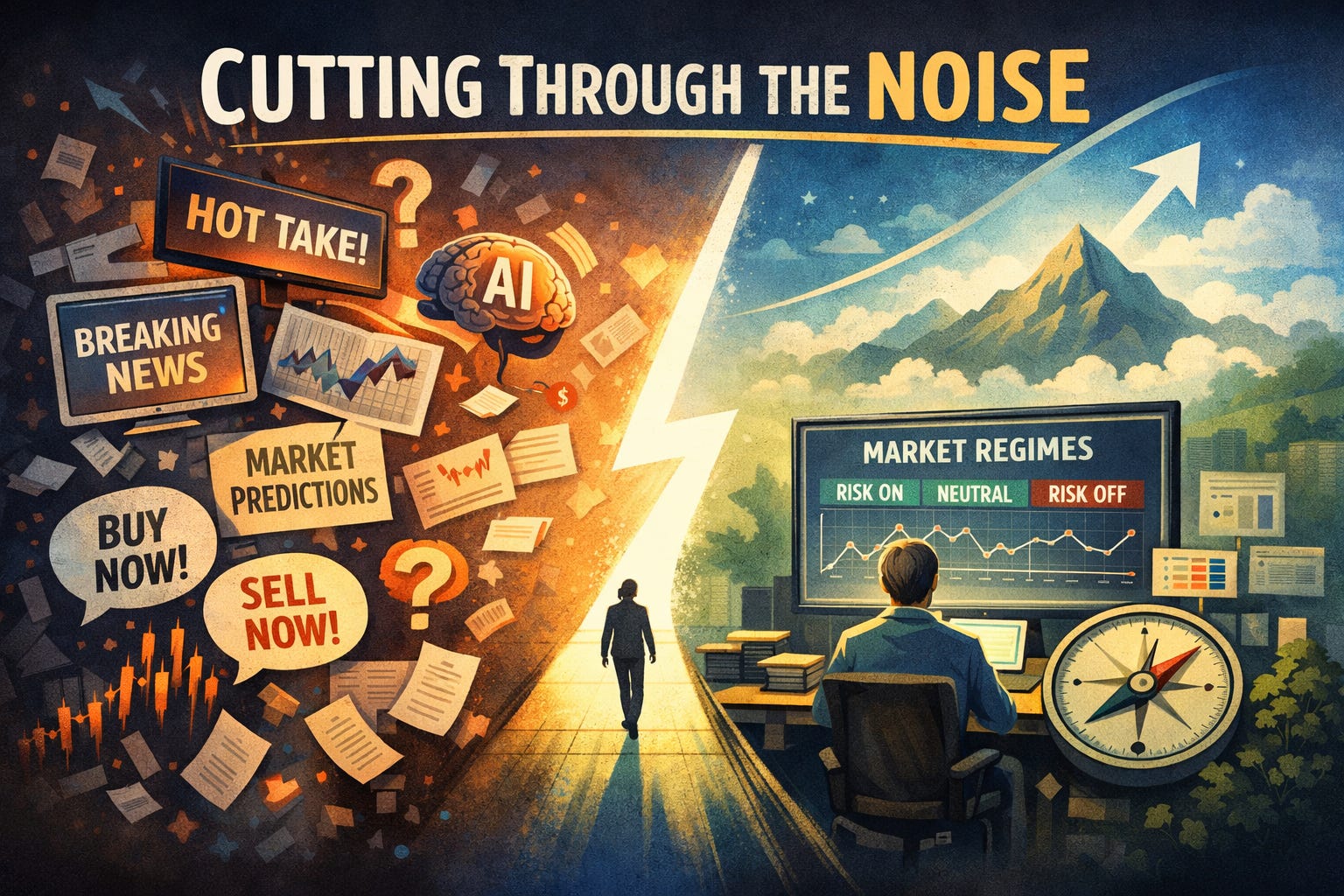
We are entering a period where intelligence is becoming abundant.
Artificial intelligence can now summarize earnings calls, scan thousands of headlines in seconds, generate trade ideas, simulate strategies, and produce confident explanations for almost any market move. The tools are impressive. They are accelerating quickly. And they are only going to get better.
But as intelligence becomes cheaper and faster, something else increases alongside it.
Noise.
The Coming Flood of “Hot Takes”
When information was expensive to produce, commentary was naturally limited. Publishing required friction. Analysis required time. Opinions had barriers.
AI removes much of that friction.
It is now trivial to generate:
Instant market reactions
Data-driven charts
Confident explanations
Highly persuasive narratives
The result will not be a shortage of insight. It will be a surplus of it.
Every market move will have dozens of interpretations. Every data release will produce hundreds of takes. Every technical level will have an AI-generated probability attached to it.
The challenge will no longer be access to information.
The challenge will be filtering it.
More Intelligence Doesn’t Automatically Create Clarity
There is a subtle assumption embedded in the AI conversation — that more intelligence equals better outcomes.
In markets, that isn’t necessarily true.
Markets are not solved by the fastest summary or the most eloquent explanation. They are probabilistic systems driven by human behavior, liquidity flows, and structural forces that don’t always respond cleanly to analysis.
In fact, more interpretation often leads to more overreaction.
When every pullback can be explained in real time, the temptation to act increases. When every rally has a narrative attached to it, conviction becomes easier — even if it’s misplaced.
Abundant analysis can create the illusion of control.
But control and understanding are not the same thing.
Signal Becomes Scarcer When Noise Becomes Cheaper
AI will make it easier than ever to sound informed.
It will also make it easier than ever to mistake commentary for edge.
As the volume of opinions increases, true signal becomes harder to identify. Not because signal disappears — but because it is buried beneath layers of interpretation.
In that environment, complexity can feel sophisticated. A strategy that references dozens of inputs and adapts dynamically to every new development can appear superior.
Yet complexity often introduces fragility.
The more variables involved, the more opportunities there are to react emotionally to short-term noise disguised as insight.
Why I Choose Simplicity
My market regime strategy is intentionally simple.
It does not attempt to interpret every headline.
It does not react to every economic release.
It does not require constant re-optimization.
It asks a narrower question:
Is the broader environment risk-seeking or risk-averse?
From there, it allocates accordingly.
That structure is not designed to win every week. It is designed to reduce decision fatigue and prevent overreaction. It focuses on process over prediction.
In a world where AI can generate thousands of signals per day, the ability to ignore most of them becomes an advantage.
Simplicity is not a rejection of technology. It is a filter.
Structure Over Stimulation
AI-driven markets will likely feel faster. Reactions will be quicker. Narratives will form instantly. Volatility may cluster around information events as algorithms and humans process the same data in real time.
The temptation will be to respond to everything.
A structured regime approach does the opposite. It acknowledges that most information does not require action. It waits for broader conditions to shift before adjusting exposure.
That patience is not passive. It is deliberate.
Structure creates distance between stimulus and response. In trading, that distance often determines survival.
The Real Edge May Be Emotional
As analytical tools improve, emotional discipline may matter more, not less.
When everyone has access to AI-enhanced research, the differentiator will not be who has the best chart or the fastest summary. It will be who can execute consistently without being pulled into every emerging narrative.
A simple, rules-based framework reduces the number of decisions that need to be made in the heat of the moment. It provides clarity when commentary becomes overwhelming.
In that sense, the edge is not superior prediction.
It is the ability to stay aligned with a predefined process while the noise grows louder.
The Long View in an Accelerated World
AI will reshape industries. It will reshape markets. It will reshape how information flows.
What it will not change is the underlying truth that markets reward disciplined behavior over time.
In an environment flooded with confident explanations and rapid-fire analysis, the most valuable skill may be restraint.
The discipline to follow a simple framework.
The patience to let probabilities play out.
The humility to admit that not every data point demands action.
As intelligence becomes abundant, clarity will become scarce.
And sometimes clarity begins by choosing less.