
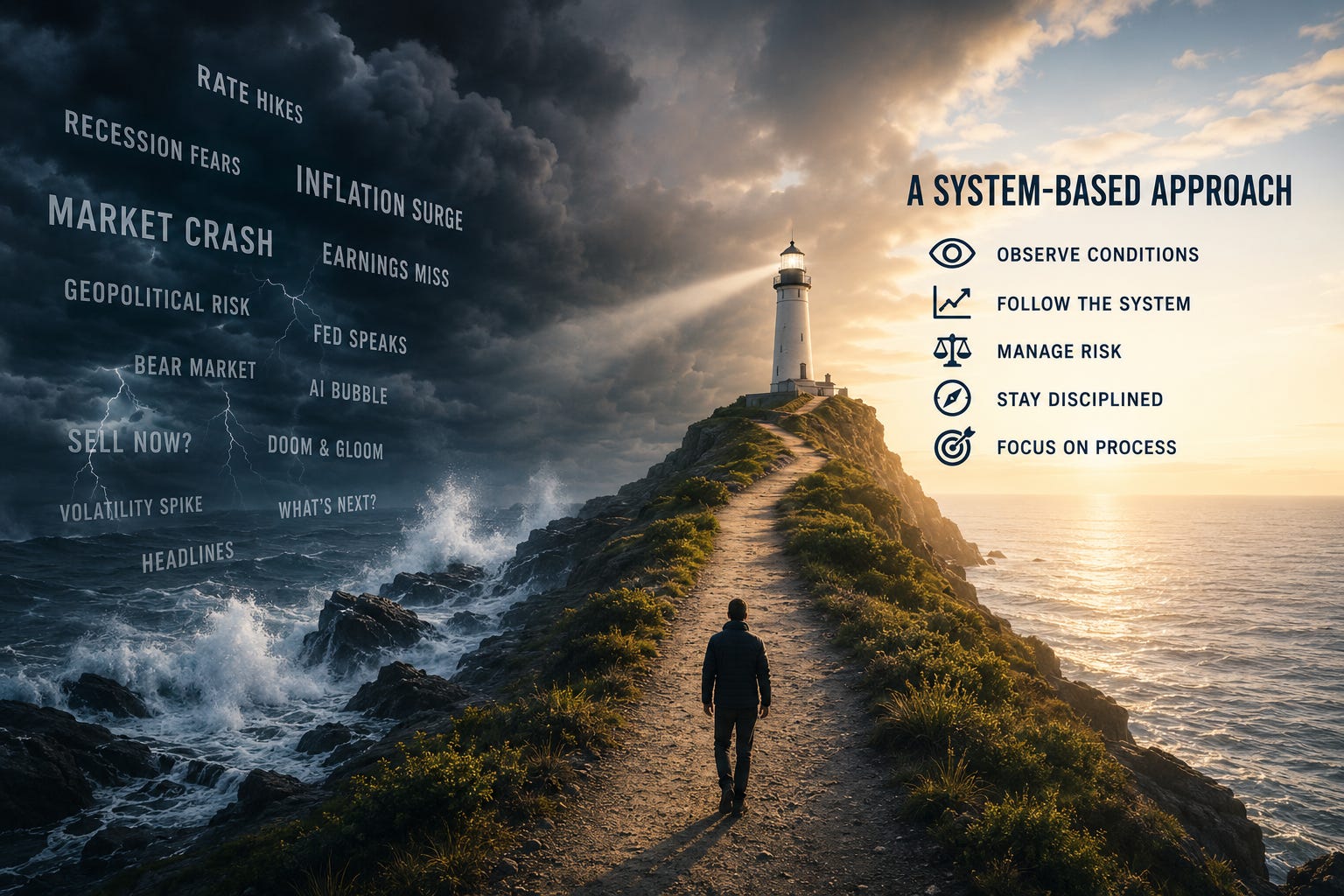
One of the hardest things for investors to accept is that markets often move without giving us a clean explanation.
We want every rally to have a reason.
Every decline to have a cause.
Every volatile stretch to fit neatly into a story we can understand.
That instinct is natural. Humans are storytellers. We are constantly trying to organize uncertainty into something predictable and logical. In everyday life, that tendency is useful. Patterns help us navigate the world safely and efficiently.
But markets are different.
Markets are complex systems made up of millions of decisions happening simultaneously. Institutional funds, retail traders, pension managers, algorithms, hedgers, speculators, businesses, governments, and long-term investors are all interacting at once. By the time a headline reaches the public, the market has often already processed it.
Yet most people still approach investing as though the key to success is simply finding the “correct” explanation.
If inflation cools, they become bullish.
If inflation rises, they become bearish.
If the Fed speaks, they immediately search for what it “means” for the market.
Over time, investing becomes less about following a disciplined process and more about constantly reacting to information.
That approach feels intelligent in the moment because it creates the sensation of being informed. But being informed and being effective are not always the same thing.
The Problem With Constant Interpretation
Imagine driving across the country using nothing but opinions from strangers on the radio.
One person says the roads ahead are dangerous.
Another says conditions are improving.
A third insists a storm is coming.
A fourth says the worst is already over.
Every few minutes, the message changes.
Eventually, you stop driving confidently and start reacting emotionally to every new update.
This is how many people experience the market.
Every day brings a new narrative.
A new prediction.
A new reason to panic or become euphoric.
The result is mental exhaustion.
Not because investing itself is inherently exhausting, but because emotional decision-making requires constant energy. Every headline feels urgent. Every market move feels personal. Every drawdown feels like proof that something must immediately change.
Most investors are not defeated by the market itself.
They are defeated by the psychological weight of constantly interpreting it.
Why Systems Matter
A system-based approach changes the relationship entirely.
Instead of asking, “What do I think will happen next?” the question becomes, “What are conditions currently telling me?”
That may sound like a small distinction, but it changes everything.
Prediction tries to control uncertainty.
A system tries to respond to it.
One approach depends on being right about the future. The other depends on having a repeatable process that can adapt as conditions evolve.
Good systems are not magical forecasting tools. They will never perfectly avoid every decline or capture every rally. That is not the objective.
The objective is consistency.
Consistency during euphoric markets when greed starts pulling people into excessive risk.
Consistency during corrections when fear convinces investors to abandon long-term plans.
Consistency during noisy periods when the temptation to override a process becomes overwhelming.
In many ways, a system acts like a stabilizer. It creates structure when emotions naturally fluctuate.
And emotions always fluctuate.
The Market Does Not Reward Certainty
One of the more uncomfortable truths about investing is that confidence is often mistaken for competence.
People are naturally drawn toward bold predictions because certainty feels reassuring. A person speaking confidently about the future sounds more credible than someone calmly admitting uncertainty.
But markets do not reward confidence alone.
History is filled with investors who sounded brilliant right before being completely wrong.
The reality is that uncertainty is permanent. No amount of research, intelligence, or market experience removes that fact. The future will always contain unknown variables.
That realization can either feel terrifying or freeing.
For system-based investors, it is freeing.
Because once you stop believing you must predict every move, you can redirect your energy toward something more productive: building a process capable of surviving many different environments.
That shift is subtle, but important.
It replaces ego with structure.
Reaction with discipline.
Prediction with observation.
Discipline Rarely Feels Exciting
There is a reason disciplined investing feels boring compared to prediction-driven investing.
Discipline is repetitive.
It often means doing the same thing over and over while the world around you becomes emotional. It means respecting rules even when headlines are persuasive. It means accepting that good investing can sometimes feel uncomfortable in the short term.
Most worthwhile things in life work this way.
Physical fitness is usually built through ordinary daily habits, not dramatic transformations.
Strong relationships are built through consistency, not intensity.
Successful businesses often rely on repeatable systems rather than bursts of inspiration.
Investing is no different.
The investors who survive long enough to benefit from compounding are often the ones who learn how to stay emotionally stable while others are constantly reacting.
Not because they lack emotions.
Because they understand emotions are temporary, while process is durable.
A Calmer Way to Navigate Markets
The goal of investing is not to eliminate uncertainty.
That is impossible.
The goal is to operate effectively within uncertainty without allowing emotions to dictate every decision.
That philosophy sits at the center of the Market Regime approach.
Not prediction.
Not sensationalism.
Not pretending to know what the market will do next week.
Just a structured framework designed to observe market conditions objectively and respond consistently over time.
For readers interested in seeing how that philosophy is applied in practice, the Current Regime page provides a real-time view of the framework without relying on forecasts or narratives:
https://www.marketregimes.com/current-regime
Because over the long run, investing success is often less about predicting the future perfectly and more about having a process stable enough to endure uncertainty when it inevitably arrives.