

Most people approach trading with a short horizon.
They evaluate performance over weeks, months, or perhaps a single year. Strategies are judged quickly. Results are expected immediately. If a system struggles for a period of time, the natural reaction is to search for something better.
This mindset is understandable, but it often misses a deeper reality of markets.
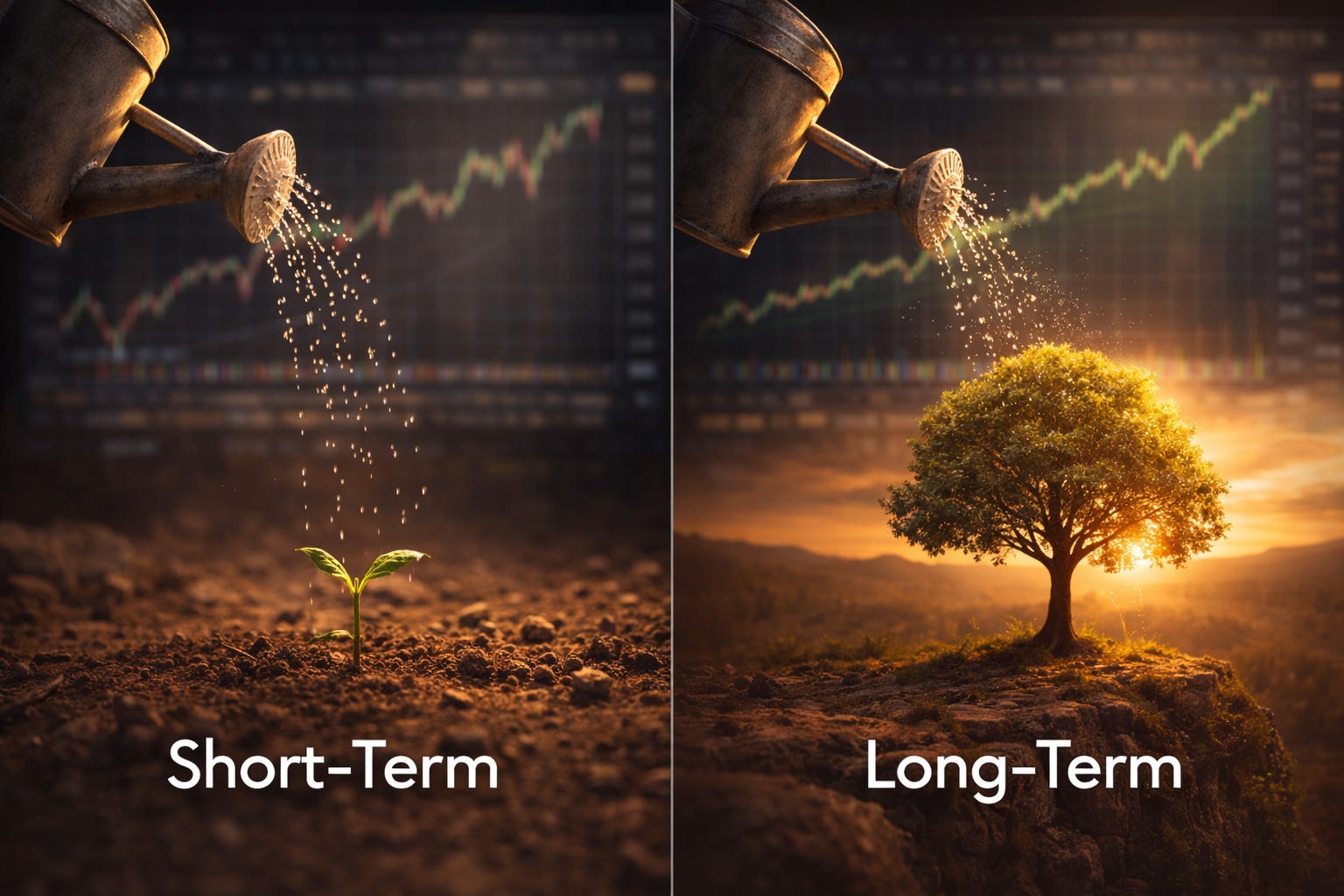
Trading is not a short-term contest.
It is a long-term compounding process.
And the traders who succeed over decades tend to approach the game very differently from those focused on short-term results.
Markets move in cycles
Financial markets are not static systems. They move through cycles of expansion, contraction, momentum, and consolidation. Strategies that perform well in one environment may struggle in another.
These cycles can last months or even years.
When traders evaluate performance over short windows, they often mistake normal environmental shifts for structural problems in their strategy. The system appears broken when it may simply be operating in an unfavorable regime.
Without a long time horizon, these periods feel intolerable.
With a longer perspective, they appear as expected parts of the process.
The temptation to restart
One of the most common patterns in trading is the cycle of reinvention.
A trader develops a strategy, experiences a period of underperformance, and begins searching for a new approach. The process starts again with research, testing, and early optimism.
For a while, the results improve. Confidence returns.
Then the environment shifts again, and the cycle repeats.
Over time, this pattern prevents compounding from ever truly beginning. The trader is always starting over.
Longevity requires resisting that impulse.
Time reveals the edge
Most systematic strategies generate their advantage gradually. The edge may be small on any individual trade, but over a large number of observations the results begin to compound.
This process requires time.
Short observation windows can make good systems look inconsistent and bad systems appear promising. Randomness dominates small samples.
Over longer horizons, however, statistical edges begin to reveal themselves.
Patience is not just a virtue in trading.
It is a requirement.
Survival is the first objective
In many professions, success comes from maximizing performance as quickly as possible. Trading is different.
The primary objective is survival.
A trader who remains solvent and disciplined across many market cycles gains something extremely valuable: the ability to continue participating. That continued participation allows the compounding process to unfold.
Aggressive behavior that leads to early failure removes that possibility entirely.
Longevity creates opportunity.
The quiet power of compounding
Compounding is often discussed mathematically, but its practical implications are easy to underestimate.
Small advantages, applied consistently over long periods, can produce extraordinary outcomes. But compounding only works when the process continues uninterrupted.
Strategies that change frequently interrupt that process. Emotional decisions interrupt it. Excessive risk interrupts it.
Consistency allows it to operate.
Experience compounds too
Another often overlooked advantage of longevity is experience.
Traders who remain active for many years observe multiple market environments. They witness different types of volatility, sentiment shifts, and regime transitions. Patterns that once felt surprising gradually become familiar.
This experience changes the psychological relationship with markets.
Events that once triggered anxiety become expected parts of the landscape. Drawdowns feel less alarming. Discipline becomes easier to maintain.
Time itself becomes an asset.
Final thought
Many traders search endlessly for a better strategy.
But the real edge in markets may be much simpler.
Stay in the game.
A robust system, reasonable position sizing, and disciplined execution create the conditions for compounding to work. The rest is patience.
In trading, longevity is not just helpful.
It is the edge.