
The Hidden Constraint
Most investors think in terms of direction.
Up or down.
Bullish or bearish.
Right or wrong.
But there’s another force at play that quietly shapes outcomes:
How fast the market is willing to move.
Because not every environment allows for big gains.
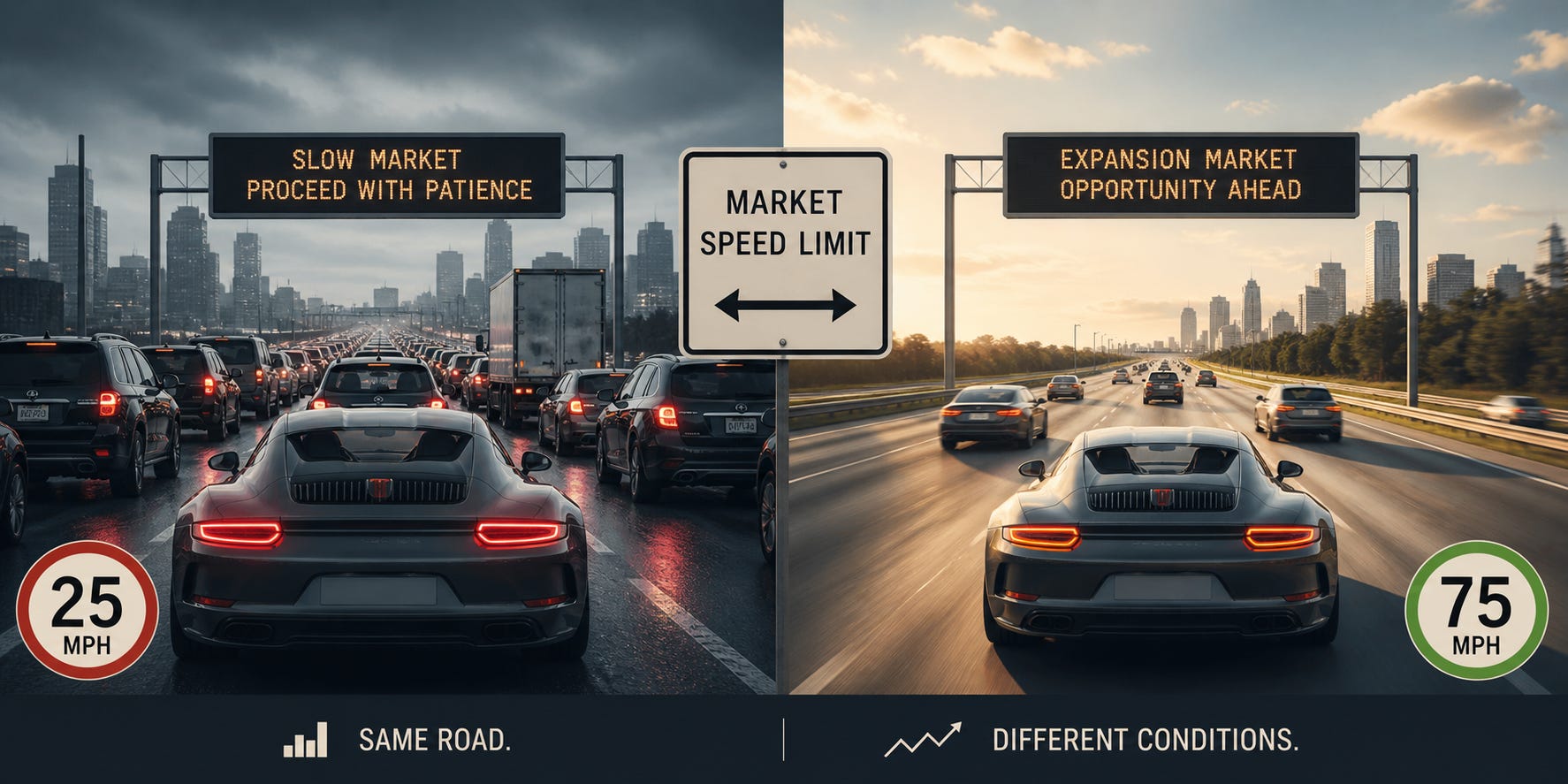
Some periods are like open highways.
Others feel like rush hour traffic.
And if you don’t recognize the difference, you’ll constantly feel like something is “off.”
Understanding It Simply
Imagine you’re driving.
Your car might be capable of going 120 mph.
But if you’re stuck in city traffic, that capability doesn’t matter.
You’re limited by the environment.
The market works the same way.
There are times when:
Trends are strong
Breakouts follow through
Momentum builds on itself
And there are times when:
Moves stall quickly
Breakouts fail
Everything feels choppy and random
It’s not about your skill suddenly disappearing.
It’s about the market’s “speed limit” changing.
Where Most People Misread It
This is where frustration creeps in.
People bring the same expectations into every environment.
They expect:
Big winners in slow markets
Clean trends in choppy conditions
Follow-through when the market isn’t offering it
So what do they do?
They press harder.
They take more trades.
They size up.
They chase moves that aren’t there.
And when it doesn’t work, they assume:
“I need a better strategy.”
In reality, they’re just asking the market for something it’s not currently providing.
Why This Matters in Real Markets
You’ve felt this before, even if you didn’t label it.
There are stretches where everything clicks.
Trades work.
Moves extend.
Confidence builds naturally.
Then there are stretches where:
Nothing follows through.
Good setups go nowhere.
Small gains get erased quickly.
Same process.
Different environment.
The difference isn’t you.
It’s the market’s capacity to move.
And if you don’t adjust to that, you’ll constantly overreach.
Systems Don’t Fight the Speed Limit
This is where a rules-based approach changes everything.
A good system doesn’t try to force opportunity.
It recognizes when:
The market is offering expansion
The market is offering contraction
And it adjusts accordingly.
Sometimes that means being aggressive.
Other times, it means doing less.
A lot less.
Because discipline isn’t just about following rules.
It’s about respecting what the environment allows.
Bringing It Back to Process
Most people only focus on entries and exits.
But the real edge often comes from something simpler:
Knowing when to expect movement… and when not to.
That’s the difference between:
Forcing trades vs letting them come to you
Overtrading vs waiting for conditions to improve
Frustration vs clarity
If you want a real-time view of how the current environment is behaving, I keep a simple, rules-based read of conditions here:
https://www.marketregimes.com/current-regime
Not as a prediction.
Just as a way to stay aligned with what the market is actually offering.
The Takeaway
The market doesn’t move the same way all the time.
And it’s not supposed to.
Some periods reward aggression.
Some periods punish it.
Your job isn’t to force results.
It’s to recognize the speed of the environment…
and operate within it.