
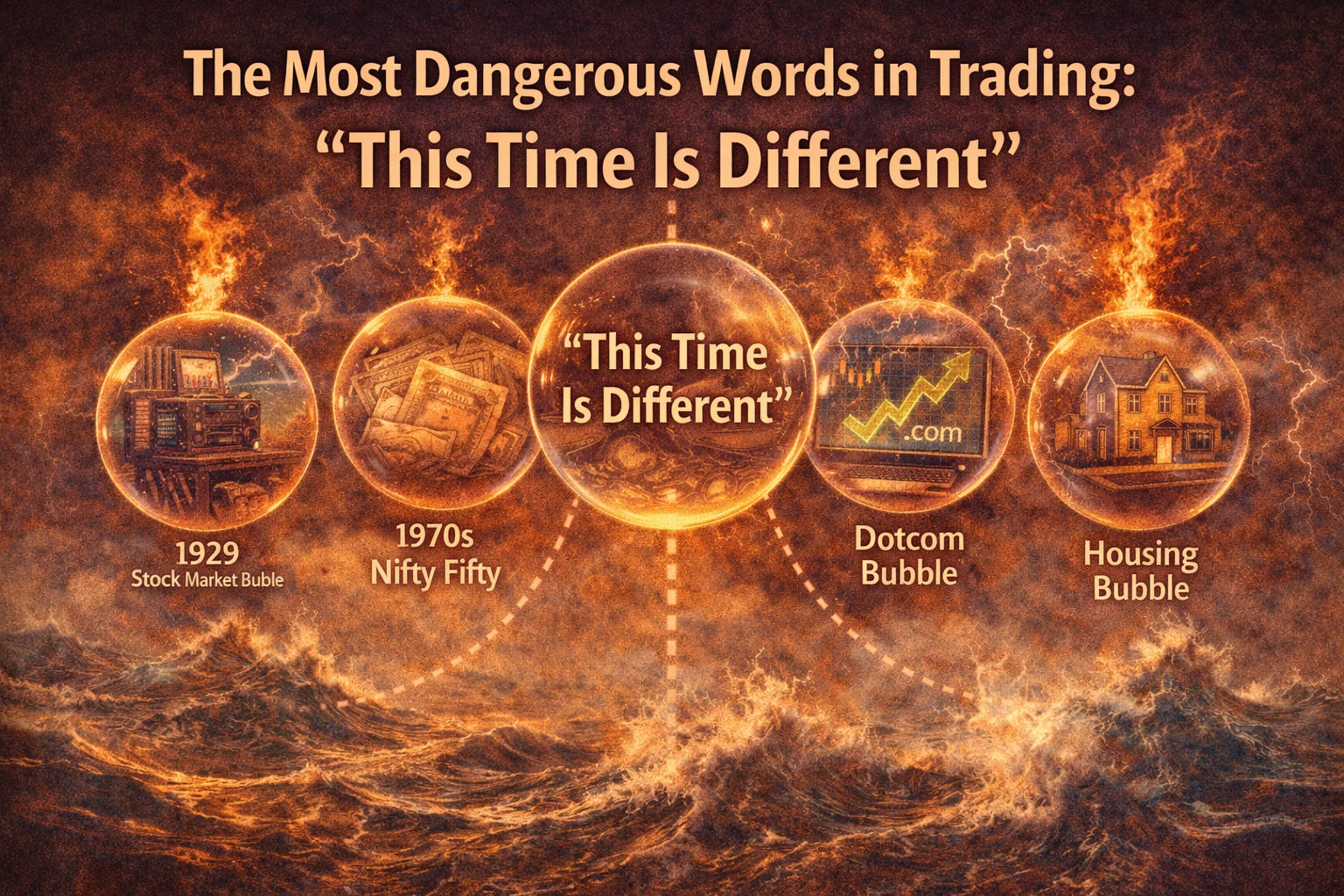
Markets have a way of convincing people that the rules no longer apply.
A new technology emerges.
A new economic environment develops.
A new narrative begins to dominate headlines.
At some point in nearly every major market cycle, a phrase starts appearing more frequently.
“This time is different.”
The argument usually sounds reasonable at first. The world is always changing, after all. Economies evolve, technology advances, and financial systems grow more complex.
But in markets, those four words have historically appeared right before some of the most painful lessons investors ever experience.
The Story We Always Tell Ourselves
Humans are natural storytellers.
When markets move strongly in one direction for long enough, people begin searching for explanations. A narrative forms that explains why the current environment is unique and why traditional risks no longer apply.
Sometimes the narrative centers on technology.
Sometimes it focuses on economic policy.
Sometimes it highlights a new financial innovation.
Eventually, the story evolves into something more powerful: a belief that past market behavior is no longer relevant.
That is when “this time is different” begins to feel convincing.
A Familiar Pattern
History suggests otherwise.
In the late 1990s, the rise of the internet convinced many investors that traditional valuation metrics no longer mattered. The digital economy was going to grow so quickly that profits would eventually justify any price.
In the mid-2000s, housing markets were believed to be uniquely stable. Real estate prices, many argued, simply did not fall nationwide.
Even earlier cycles featured similar thinking. The Nifty Fifty era in the early 1970s promoted the idea that certain companies were so dominant that they could be bought at any price and held forever.
Each time, the underlying argument was slightly different.
The conclusion was the same.
Why We Keep Believing It
The persistence of this pattern is not a coincidence.
Humans are wired to extrapolate recent experiences into the future. When something has worked for a long time, our brains naturally assume it will continue working.
Rising markets reinforce this belief. Strong performance attracts attention. Attention attracts capital. Capital pushes prices even higher, which further strengthens the narrative.
At some point, the explanation for rising prices becomes detached from underlying fundamentals.
But by then, the story has already taken hold.
The Power of Narratives
Narratives are powerful because they simplify complexity.
Markets are incredibly complicated systems influenced by thousands of variables. Most participants cannot analyze every factor, so stories become a shortcut for understanding what is happening.
“This time is different” provides an especially comforting story. It suggests that the past no longer constrains the future. It allows investors to dismiss historical risks and focus entirely on opportunity.
In other words, it removes the need for caution.
Unfortunately, markets have a long history of punishing that belief.
The Discipline of Systems
This is one of the reasons systematic trading frameworks exist.
A well-designed system does not rely on narratives. It does not attempt to determine whether the current environment is fundamentally different from the past. Instead, it focuses on observable conditions and predefined rules.
The system responds to what markets are doing rather than to what people believe markets should do.
That distinction is important.
Narratives can change quickly. Headlines shift. Sentiment swings. Conviction rises and falls with every new piece of information.
A structured framework provides something far more stable: consistency.
Humility in Markets
Perhaps the greatest advantage of systematic approaches is humility.
They acknowledge that markets are complex and that human interpretation is often flawed. They assume that narratives will emerge, that confidence will periodically become excessive, and that cycles will continue repeating in ways that feel new but ultimately follow familiar patterns.
Instead of attempting to identify when “this time is truly different,” the system simply adapts to changing conditions through predefined mechanisms.
It does not require predicting the future.
It only requires responding to the present.
The Words That Should Raise Caution
When investors become convinced that the rules have changed, it often signals that risk is being underestimated.
That does not mean innovation is unimportant. Technology evolves, economies shift, and markets do adapt over time.
But the fundamental forces of human psychology — fear, greed, optimism, and overconfidence — remain remarkably consistent.
Which is why the phrase “this time is different” has echoed through so many cycles.
Markets change.
Human behavior rarely does.
And in trading, forgetting that difference can be extremely expensive.