
Modern financial markets are fast, abstract, and emotionally demanding.
Prices change in milliseconds. News travels globally in seconds. Capital moves at a scale and speed that would have been unimaginable even a generation ago.
Many people imagine that good trading feels confident.
The charts line up. The signal is obvious. You place the trade with conviction and watch it work exactly as expected.
In reality, good trading rarely feels like that.
More often, it feels uncomfortable.
The actions that produce the best long-term outcomes frequently run directly against our instincts. The things that feel emotionally satisfying in the moment are often the behaviors that damage results over time.
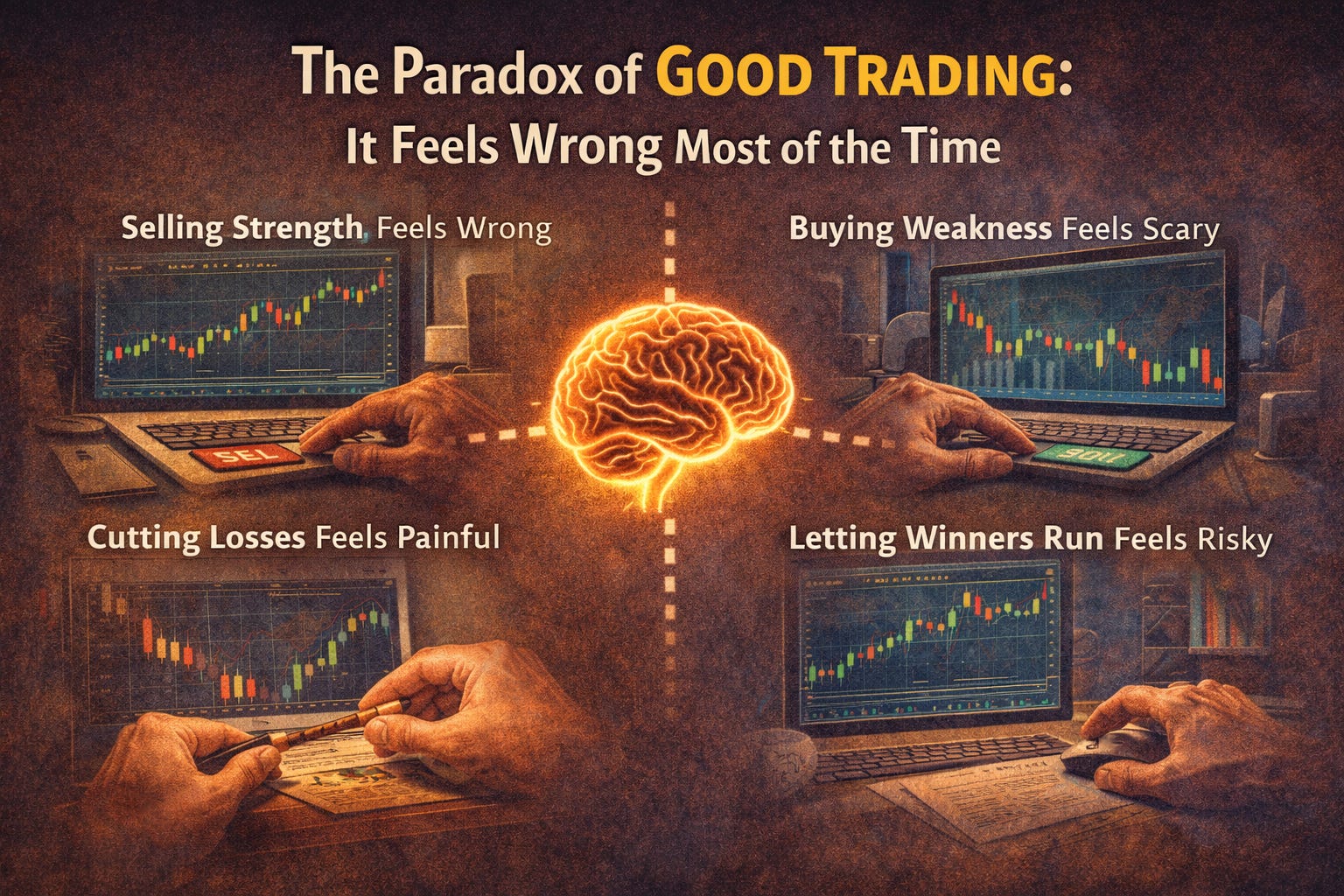
This creates one of the central paradoxes of trading: the correct decision often feels wrong.
Selling When Things Look Good
One of the most uncomfortable things a trader can do is sell into strength.
When prices are rising, news is positive, and optimism is building, the natural instinct is to stay involved. Momentum creates a sense of safety. It feels like the move should continue.
Selling during those moments can feel premature. It creates the fear of missing out if the trend continues.
Yet disciplined trading often requires reducing exposure precisely when things feel most comfortable. Risk management is not based on how good the environment feels, but on predefined rules and position limits.
The system does not care about the excitement of the moment. It cares about protecting capital.
Buying When Things Feel Scary
The opposite situation can feel even worse.
Markets pull back. Headlines turn negative. Sentiment deteriorates. The instinct is to step away and avoid further pain.
This is when many traders hesitate.
Buying during uncertainty can feel reckless, even when a structured framework indicates that conditions remain favorable over the longer term. Emotionally, it feels safer to wait for reassurance.
But by the time reassurance arrives, much of the opportunity is often gone.
Systematic approaches exist partly to overcome this hesitation. They allow decisions to be based on structure rather than on how the moment feels.
Cutting Losses Feels Like Failure
Losses trigger something deeper than simple disappointment.
Psychological research consistently shows that humans feel losses more intensely than gains of the same size. Losing money can feel like a personal mistake rather than a normal part of a probabilistic process.
Because of this, many traders resist cutting losses. They hold positions longer than planned, hoping the market will recover and remove the discomfort.
But disciplined trading requires accepting small losses early.
Closing a losing position according to plan can feel frustrating in the moment. It feels like admitting defeat.
In reality, it is often the action that protects the entire strategy.
Letting Winners Run Feels Risky
Interestingly, even profitable trades can create discomfort.
When a position moves in your favor, the urge to lock in gains becomes strong. Taking profits provides emotional relief. It converts uncertainty into certainty.
But exiting too early often limits the ability to capture the larger moves that drive long-term performance.
Allowing a winning position to continue requires tolerating the possibility that profits may partially retrace. That uncertainty can feel unpleasant, even when the strategy calls for patience.
The irony is that the trades that ultimately make the biggest difference often require the most emotional restraint.
The Instinct Problem
None of these reactions are signs of weakness.
They are simply human.
For most of our history, humans evolved in environments where fast emotional responses were essential for survival. Fear helped us avoid danger. Taking advantage of opportunity quickly helped ensure access to scarce resources.
Those instincts served our ancestors well.
Financial markets, however, operate differently. They are probabilistic systems where outcomes unfold over time rather than immediately.
Our instincts are designed for survival, not for trading.
Why Structure Matters
This is where systematic approaches become powerful.
A structured trading framework does not eliminate emotion, but it prevents emotion from controlling decisions. Rules are established in advance, during calm conditions, when judgment is clearer.
Instead of relying on instinct in stressful moments, the process guides behavior.
The system determines when exposure should increase or decrease. It defines acceptable risk. It removes the need to constantly reinterpret every short-term move in the market.
Over time, this structure creates consistency.
Embracing the Discomfort
One of the quiet signals that a trading process is working is that it occasionally feels uncomfortable.
Selling when the crowd is optimistic can feel wrong.
Buying when uncertainty is elevated can feel wrong.
Accepting a small loss can feel wrong.
Allowing a profitable trade to continue can feel risky.
Yet these moments are often where discipline matters most.
Good trading does not eliminate emotion. It simply prevents emotion from driving the process.
The paradox is that if trading always feels comfortable, something may be wrong.
Because in markets, the correct decision often feels like the hardest one to make.