
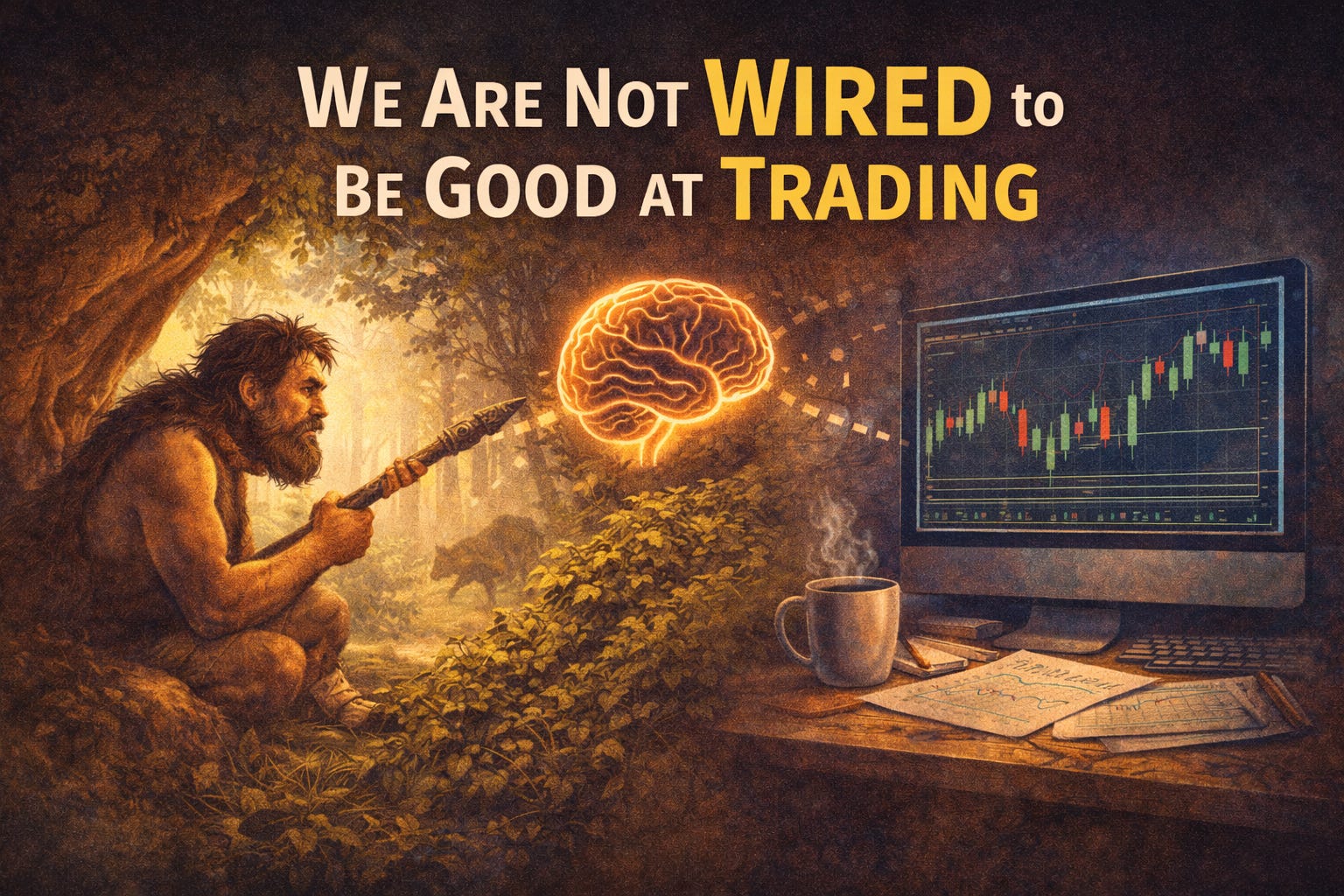
Modern financial markets are fast, abstract, and emotionally demanding.
Prices change in milliseconds. News travels globally in seconds. Capital moves at a scale and speed that would have been unimaginable even a generation ago.
And yet the brain making trading decisions inside this system is not modern at all.
Homo sapiens have existed for roughly 300,000 years. For the overwhelming majority of that time, humans lived as hunter-gatherers in small tribes, navigating a world defined by immediate physical threats, scarce resources, and short-term survival decisions.
Our brains were shaped in that environment.
Financial markets have existed for only a few hundred years. Electronic markets for only a few decades.
Evolution hasn’t had time to catch up.
The Rustling in the Bushes
Imagine standing in tall grass 50,000 years ago and hearing something move nearby.
That rustling could be the wind.
Or it could be a predator.
If you ignore it and you’re wrong, you die.
If you overreact and you’re wrong, you burn a few calories.
Evolution strongly favors the overreaction.
As a result, our brains are wired to respond quickly and emotionally to perceived threats. The amygdala activates. Stress hormones rise. Attention narrows.
Now replace the rustling bushes with a sharp market decline.
A red screen triggers the same ancient circuitry. Your heart rate increases. You feel urgency. You want to act immediately.
But unlike a predator, a market drawdown does not require instant survival action. In fact, impulsive reactions are often what create permanent losses.
The survival instinct that kept our ancestors alive can work against us in a probabilistic financial system.
Feast When Food Is Available
Early humans also lived in a world of scarcity.
There was no grocery store. No food delivery. No guarantee of the next meal. When a hunt or scavenge was successful, the logical response was to eat — a lot. Store energy. Take advantage of abundance while it was available.
This behavior was adaptive. It increased survival odds.
In modern markets, it manifests as greed.
When a trade works quickly, the instinct is to press harder. Increase size. Double down. Extract as much as possible before the opportunity disappears.
The brain treats profits like scarce food.
But markets are not one-time hunts. They are ongoing systems governed by probabilities. Overexposure during favorable periods often leads to disproportionate damage when conditions shift.
Feast-and-famine thinking creates volatility in decision-making.
A Brain Built for Certainty
Our ancestors dealt with tangible problems:
Is that animal dangerous?
Is there food nearby?
Is this person friend or foe?
These were binary, immediate questions.
Markets are different. They operate in shades of probability. There are no certainties — only distributions of outcomes. A trade can be well-structured and still lose money. A reckless decision can still pay off in the short term.
This ambiguity is deeply uncomfortable for the human brain.
Behavioral finance research consistently shows that humans:
Feel losses more intensely than equivalent gains
Overweight recent information
Seek patterns in randomness
Overestimate their predictive abilities
These are not flaws in character. They are cognitive shortcuts developed to help us survive.
But in trading, those shortcuts often distort judgment.
The Emotional Mismatch
Markets constantly trigger ancient emotional systems.
A rally stimulates reward circuitry and increases confidence.
A drawdown activates loss aversion and fear.
A string of wins creates overconfidence.
A string of losses creates paralysis.
Our nervous systems were designed for short bursts of stress, followed by resolution. Trading, however, exposes us to continuous uncertainty. The feedback loop never ends. Prices fluctuate all day, every day.
Expecting pure willpower to override 300,000 years of evolutionary wiring is unrealistic.
Emotion is not the exception in trading.
It is the default.
Why Systematic Trading Works
This is precisely why a systematic framework is powerful.
A rules-based system does not eliminate emotion, but it reduces its influence. Decisions about entry, exit, sizing, and allocation are defined in advance — ideally during calm conditions rather than in moments of stress.
Instead of reacting to every perceived threat, the system filters noise.
Instead of feasting impulsively during favorable conditions, it manages exposure deliberately.
Instead of improvising under pressure, it executes predefined rules.
The structure becomes a buffer between ancient instincts and modern complexity.
It acknowledges that we are not wired for probabilistic decision-making under constant emotional stimulus — and it designs around that limitation.
Trading Against Your Biology
Perhaps the most important realization for any trader is this:
Feeling fear does not mean you are weak.
Feeling greed does not mean you are reckless.
It means you are human.
The goal is not to eliminate emotion. That is impossible. The goal is to prevent emotion from dictating behavior.
A systematic process accepts that our brains evolved for survival on the savannah, not for managing risk in global capital markets. Instead of relying on discipline alone, it embeds discipline into the framework itself.
Over time, that structure becomes the edge.
The Real Advantage
As technology advances and information becomes more abundant, raw intelligence becomes less differentiated. Everyone has access to charts, data, and analysis.
What remains scarce is emotional stability.
Understanding that we are biologically misaligned with modern markets changes the objective. Success is no longer about outsmarting everyone else. It is about building a process strong enough to counteract our own instincts.
Markets are modern.
Our brains are ancient.
A systematic approach bridges that gap.