
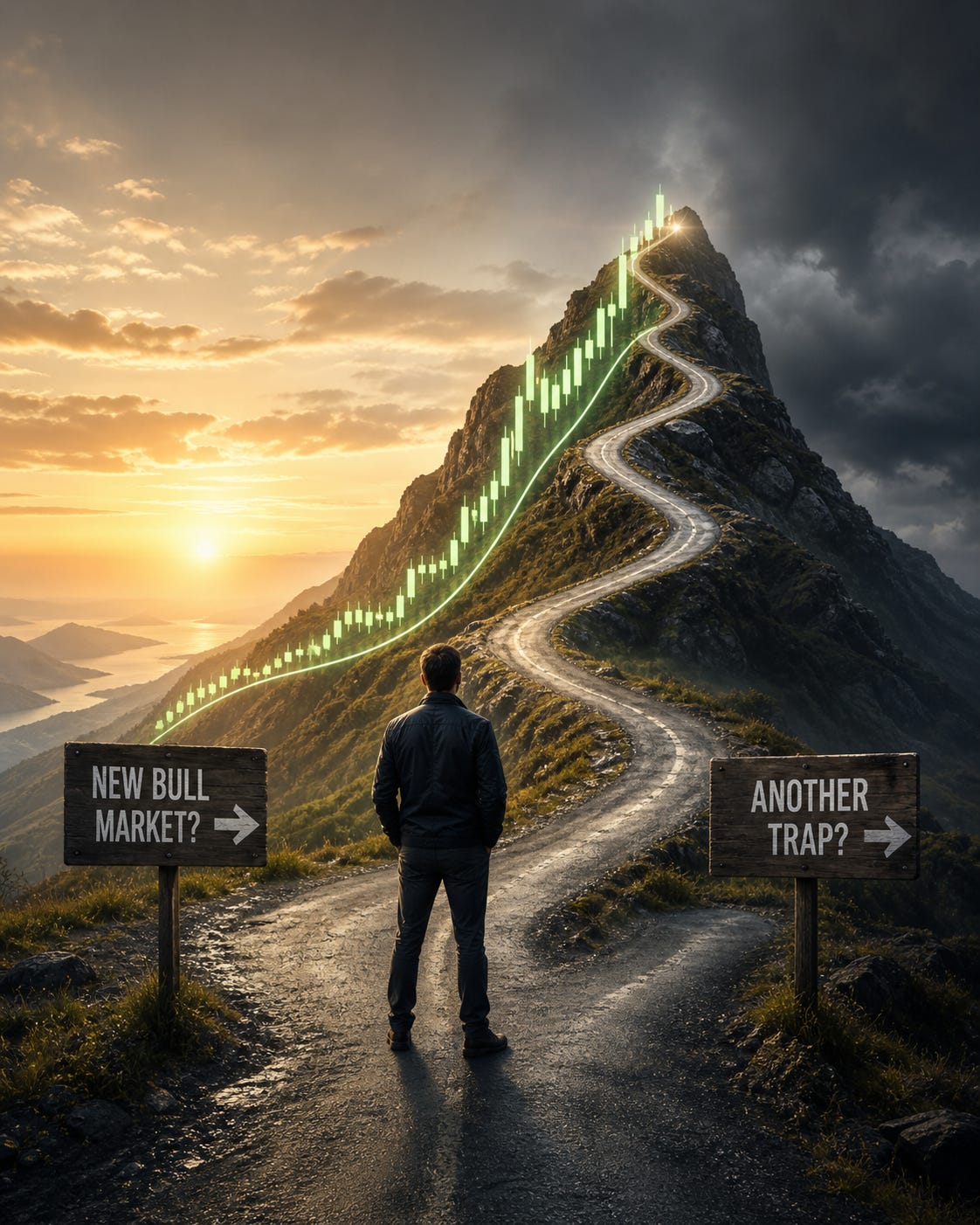
Setting the Scene
Over the past 25 trading days, the S&P 500 has risen by nearly 15%. Moves of this magnitude over such a short period are uncommon and tend to capture attention quickly.
When markets rise steadily over months or years, the experience feels orderly and easier to interpret. This type of move is different. It is fast, compressed, and forces participants to reassess what they believe is happening.
The natural question becomes whether this strength is the beginning of something sustainable or part of a shorter-term shift that will resolve differently.
What Most Investors Believe
In moments like this, interpretation tends to split.
Some investors view the move as confirmation that conditions have improved. Strength is seen as validation that the market is moving forward and that waiting carries risk of missing further gains.
Others view the same move with skepticism. They see speed as a sign of instability and assume the rally is temporary, especially if it follows a period of uncertainty or decline.
Both perspectives are understandable. Both are grounded in recent experience. And historically, both have been right at different times.
What Has Happened Before
Looking at historical data for SPY going back to 1999 , similar bursts of performance tend to appear during periods of transition rather than during calm, well-established trends.
In early 2009, after the financial crisis, the market began to rise sharply over a short window. At the time, most investors assumed it was another temporary rally within a broader downtrend. That belief was shaped by the repeated failures of prior rebounds. In reality, underlying conditions had already begun to shift, and the move marked the early stages of a sustained recovery.
In 2020, the market experienced one of the fastest recoveries in history following the initial pandemic-driven decline. The speed of the rally created confusion because it did not align with the economic reality at the time. However, the market was responding to forward expectations and an unprecedented level of liquidity rather than current conditions.
There are also examples where similar strength occurred later in a cycle. During the early 2000 period, sharp advances still appeared even as the broader structure was beginning to weaken . At the time, these moves were interpreted as continuation. In hindsight, they were part of a topping process rather than the start of a new expansion.
What Was Actually Happening Beneath the Surface
The common thread across these periods is that the visible move alone did not provide a complete answer.
Rapid advances tend to occur when positioning is shifting quickly, when uncertainty is elevated, and when the market is adjusting to new information. These conditions can exist at the beginning of a new trend, in the middle of a transition, or near the end of a cycle.
The same price behavior can reflect very different underlying environments. Without understanding those conditions, it is easy to assign the wrong meaning to the move.
What Happened Next
The outcomes following these rallies were not consistent.
In some cases, the market continued higher in a more stable and sustained way. In others, the move was followed by increased volatility or a reversal as underlying weaknesses became more apparent.
This variability is what makes these moments difficult. The magnitude of the move attracts attention, but it does not provide clarity on its own.
The Lesson
Fast and powerful rallies tend to create a sense of urgency. They encourage decisions based on recent price movement rather than on the broader environment.
However, history suggests that the move itself is not the signal. It is the context around the move that determines what it represents.
Focusing only on price can lead to conclusions that feel logical in the moment but do not align with the actual conditions driving the market.
Closing Thought
Every rapid advance tells a story, but the story is not always the same.
The challenge is not to decide immediately whether the move is the start of a new trend or something temporary. The challenge is to observe how conditions evolve after the move and to remain aligned with that environment rather than reacting to the initial surge.
If you want to see how we track these shifts in real time, you can follow along here:
https://www.marketregimes.com/current-regime