
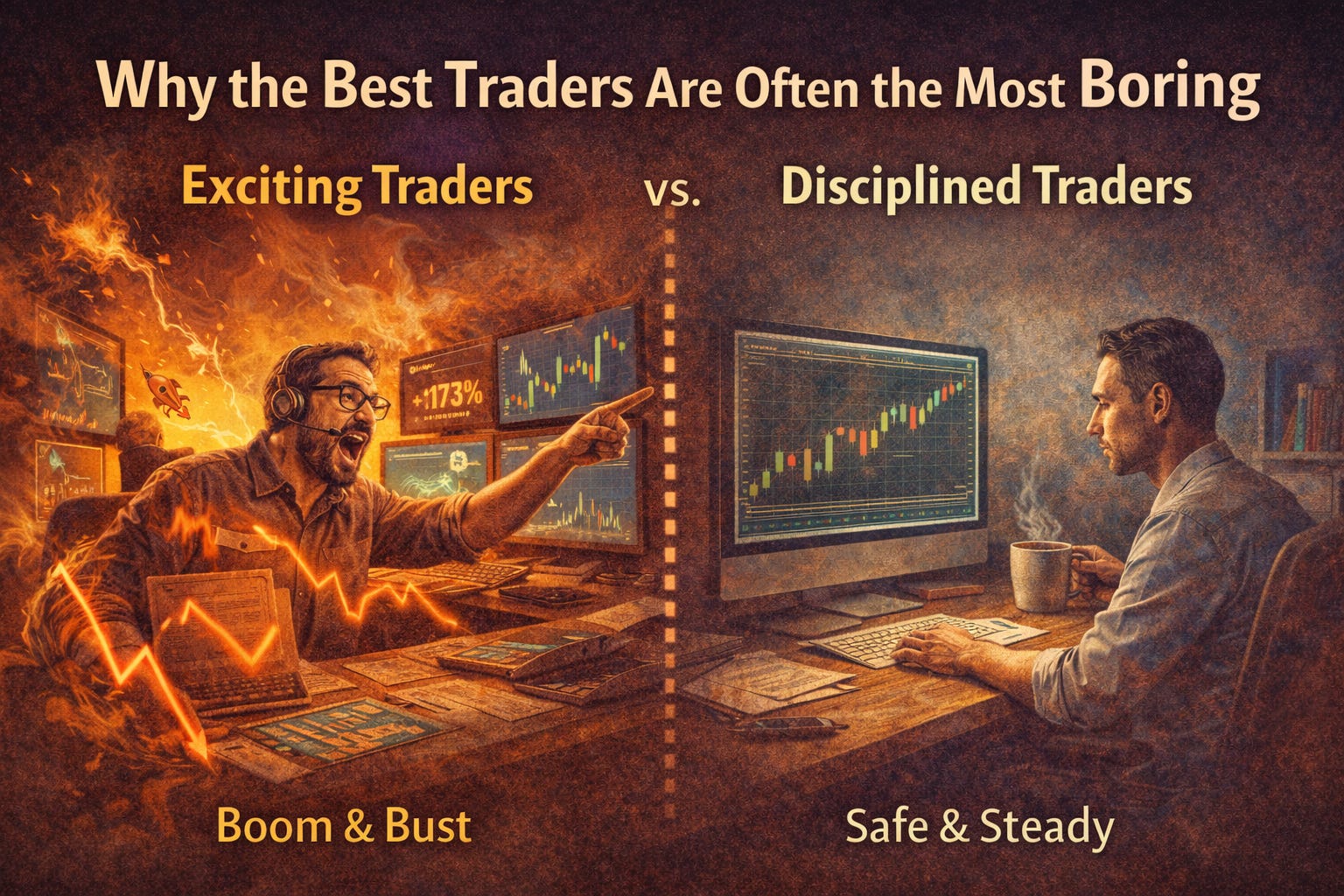
If you scroll through trading content online, the most visible traders tend to have something in common.
They are exciting.
There are bold predictions, dramatic charts, and confident declarations about where the market is going next. Trades are presented like victories. Wins are highlighted. Big days are celebrated.
It makes trading look thrilling.
But if you look closely at many of the traders who quietly compound capital over long periods of time, the picture looks very different.
The best traders are often the most boring.
The Entertainment Trap
Financial markets naturally attract attention because they contain constant movement. Prices rise and fall every day, creating an endless stream of opportunities for commentary.
In the age of social media, that movement has become content.
Every rally becomes a story.
Every dip becomes a prediction.
Every chart becomes an explanation.
The traders who thrive in this environment tend to be the ones who are most entertaining. They speak with certainty, make bold calls, and constantly present new ideas.
But entertainment and performance are not the same thing.
In fact, they often move in opposite directions.
Excitement Requires Constant Action
Exciting traders tend to be very active. They are constantly scanning for the next opportunity, reacting to the latest headline, or trying to capture the next big move.
This activity creates energy and engagement. There is always something happening.
But constant activity also increases risk.
More trades mean more opportunities for emotional decision-making. Position sizes fluctuate. Risk exposure expands and contracts quickly. Strategies shift as narratives change.
The result can look impressive for a while.
But volatility cuts both ways.
Many exciting traders produce dramatic equity curves. Large gains are followed by equally dramatic drawdowns. Some recover. Many do not.
Quiet Compounding Looks Different
The traders who survive for decades rarely operate this way.
Their approach is often far less dramatic. Instead of reacting to every move, they follow a structured process. Decisions are guided by predefined rules rather than by real-time interpretation.
Risk is managed carefully.
Exposure is adjusted gradually.
Trades are taken because the system calls for them, not because they feel exciting.
From the outside, this approach can look uneventful. There are no bold predictions and no constant stream of commentary. The focus is on consistency rather than spectacle.
Over time, that consistency produces something powerful: compounding.
The Social Media Illusion
One of the challenges of modern trading culture is that visibility favors excitement.
A trader who quietly follows a disciplined framework does not generate constant content. There are fewer dramatic stories to tell. Many days involve simply executing the same process.
A trader making bold predictions, on the other hand, always has something to post.
If the call works, it looks brilliant.
If it fails, it is quickly replaced by the next idea.
This dynamic creates a distorted perception of what successful trading looks like. The loudest voices appear the most confident, even though long-term performance often favors the quieter operators.
The Professional Mindset
Professional trading tends to prioritize something different from excitement: survival.
Markets are uncertain by nature. Even strong strategies experience losing periods. The objective is not to win every trade, but to stay in the game long enough for probabilities to work over time.
This mindset changes how decisions are made.
Risk management becomes the first priority.
Position sizing becomes deliberate.
Consistency becomes more important than excitement.
The result is a style of trading that may appear dull from the outside but is designed for durability.
Why Boring Works
Boring systems have advantages.
They are easier to follow because the rules are clear. They reduce emotional interference because decisions are made in advance. And they prevent the constant reinvention that often leads to overfitting and unnecessary risk.
Most importantly, they allow traders to focus on the long-term process rather than on short-term outcomes.
When the goal is steady compounding, drama becomes unnecessary.
The Real Signal
Over time, one pattern tends to emerge.
The traders who seek excitement often produce the most dramatic stories. They experience huge wins and devastating losses. Their results fluctuate with the intensity of their activity.
The traders who seek structure tend to produce something much less interesting.
Their returns accumulate gradually. Their drawdowns are controlled. Their decision-making remains consistent across different environments.
From the outside, this can look boring.
From the inside, it is exactly what a sustainable process should look like.
Redefining Success
The challenge for many traders is psychological.
Excitement is appealing. It creates the feeling that something important is happening. It makes trading feel dynamic and rewarding.
But markets do not reward excitement.
They reward discipline.
The goal is not to create the most interesting trading story. The goal is to build a process that works over years and decades.
Ironically, the traders who succeed at that goal often appear the least exciting.
Which may be the clearest signal of all.
"If trading is exciting, you’re probably doing it wrong" is still very true!